Scientific Opinion on Strategic Crisis Management for the EU
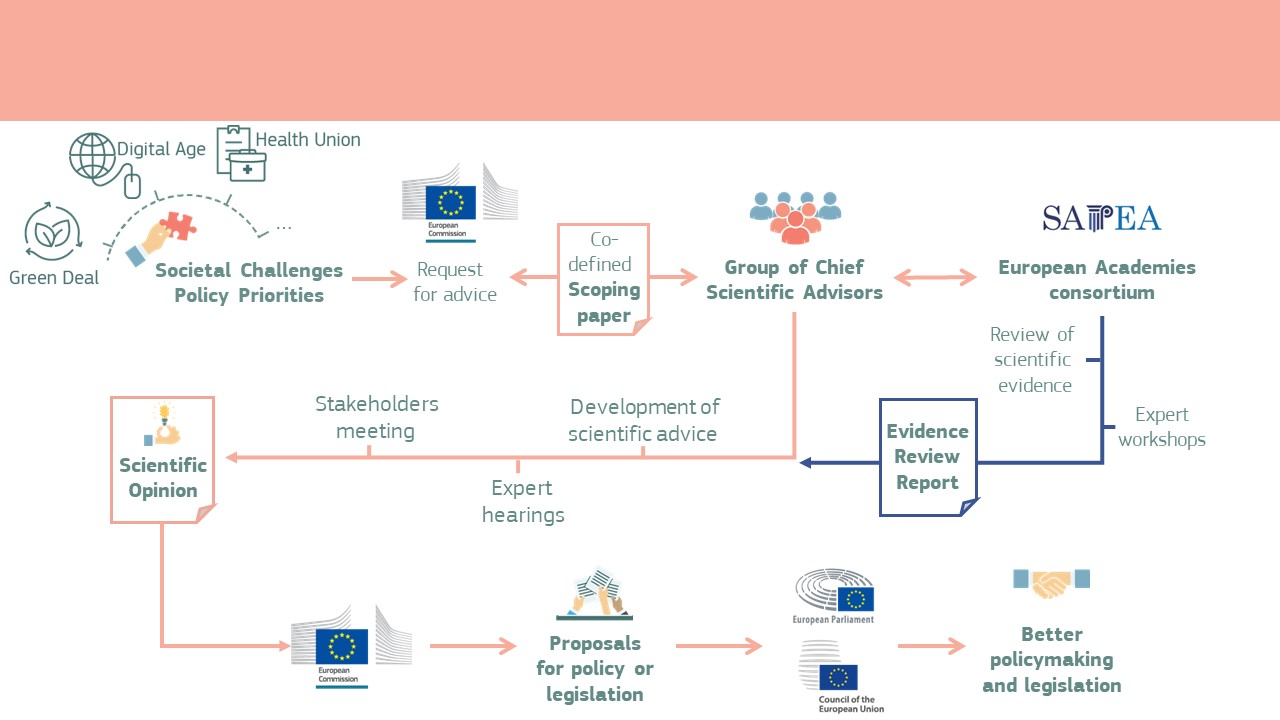
The Scientific opinion on "Strategic crisis management for the EU" following the Advisors' own initiative and mandated by Commissioners Gabriel (for Innovation, Research, Culture, Education and Youth) and Lenarčič (for Crisis Management) should address the key aspects that have been raised in the Scoping Paper issued in June 2021 and that resulted from a wide consultation with EU Commission Directorates General, Agencies and Services. It follows previous activities on crisis management of the Covid 19 pandemic (the Statement and the Scientific Opinion issued respectively in June 2020 and in November 2020) and is aimed at addressing the main gaps and opportunities for enhanced preparedness, improved response capacity and addressing recovery after major crises that may occur in the future and affect Europe at large.
The opinion will be based on an extensive evidence review report (ERR) that is currently developed by SAPEA (Scientific Advice for Policy by European Academies), on a number of consultations with diverse stakeholders internal and external to the Commission and on the contributions of international experts. The main starting point reflects the recognition, following also the Foresight Reports and Program, that the EU and the European societies are exposed and vulnerable to global hazards and a range of natural or human-made shocks which include and go beyond major health threats.
Furthermore, the Scoping Paper explicitly ask for guidance on the multi hazard nature of likely future events that imply cascading and domino effects that must be de-escalated through appropriate planning, preparedness, anticipation and prevention. Therefore, a cross sectoral approach is called for and one that addresses the entire cycle of crises, from pre-shock to response and recovery.
Whilst recognizing the added value of the existing articulated policies and of resilience as a guiding concept of EU strategies, the scoping paper also asks for a framework to help overcome the fragmentation of understanding and definitions that exist among sectoral policy strategies in the EU which may lead to fragmented crisis management mechanisms and operations. It does demand to ground on relevant knowledge that has been already produced, explicitly mentioning among others the Copernicus Service, the Disaster Risk Management Knowledge Centre, the recently launched Union Civil Protection Knowledge Network, the Climate Adapt Platform. Ultimately, the opinion should highlight what methodologies, informational and knowledge sources can help improve the European collective cognition of complex crises.