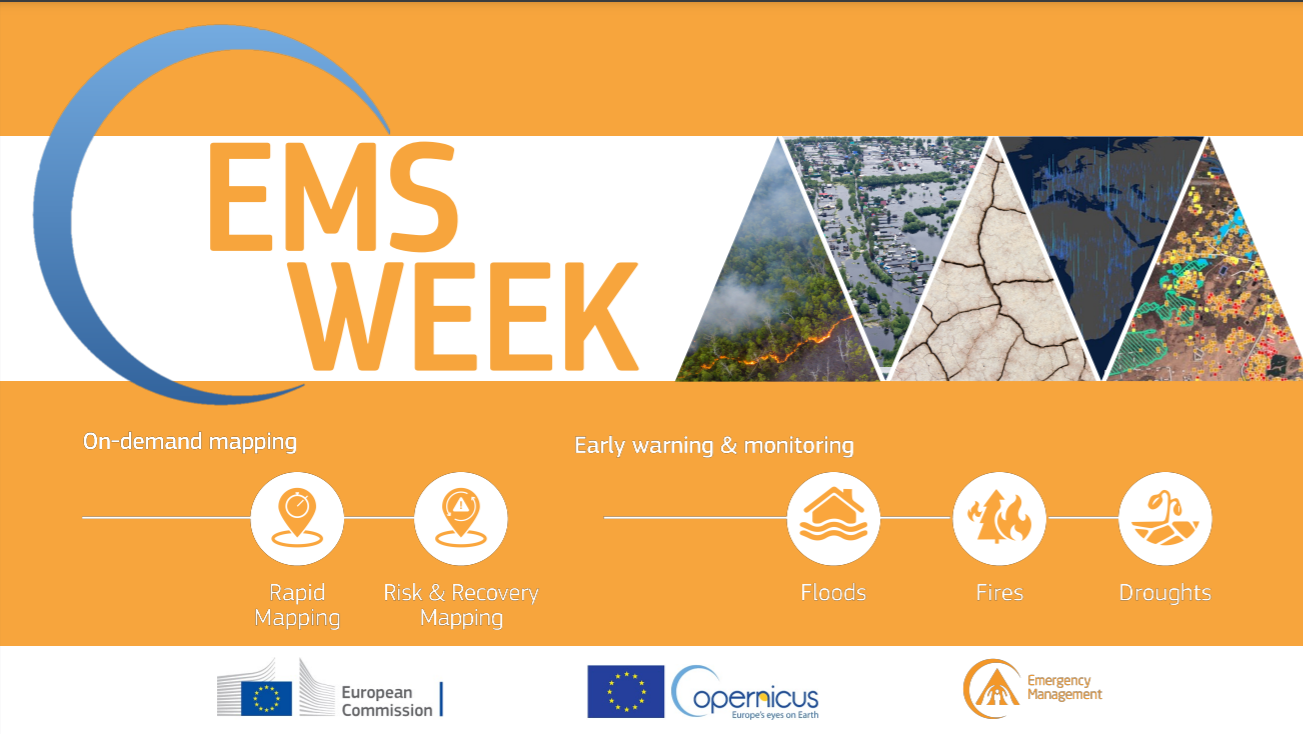
The Copernicus Emergency Management Service - CEMS Week 2021
This flagship event focused on two horizontal priorities: climate change and exploiting research & innovation. It also showcased the integration of all CEMS components in the "summer of disasters" session. Further, it offered ample room for the communities to learn and discuss progress in floods, fires, droughts and mapping. On the first day of the event, the floods team launched the "Global Flood Monitoring System", bringing a revolution to near real-time flood monitoring globally. On the last day of the event, the wildfire team released the annual report "Forest Fires in Europe, Middle East and North Africa 2020", prefaced by Commissioners Gabriel and Sinkevicius, with an EC Press Release.
The increasing demand for CEMS data to support decision-making in disaster and risk management activities, as well as the growing role of climate change and Member States' increasing reliance on geospatial information, remained a common theme among high-level introductory speeches. Clear examples of this trend are the significant flooding which took place this summer in central Europe, the Wildfire crises that took place last August, or the volcanic eruption on the Spanish island of La Palma.
Panel discussions, interviews and presentations from each of the service components followed, including the adoption of the Global Human Settlement Layer as new service component.
Check out the new Copernicus EMS video which showcases the service's contribution to early warning, response and recovery efforts globally: https://youtu.be/fjauY-FF_JE
Link to the CEMS week conclusions: https://emergency.copernicus.eu/mapping/ems/cems-week-2021-conclusions-community-insights-and-service-evolutions